
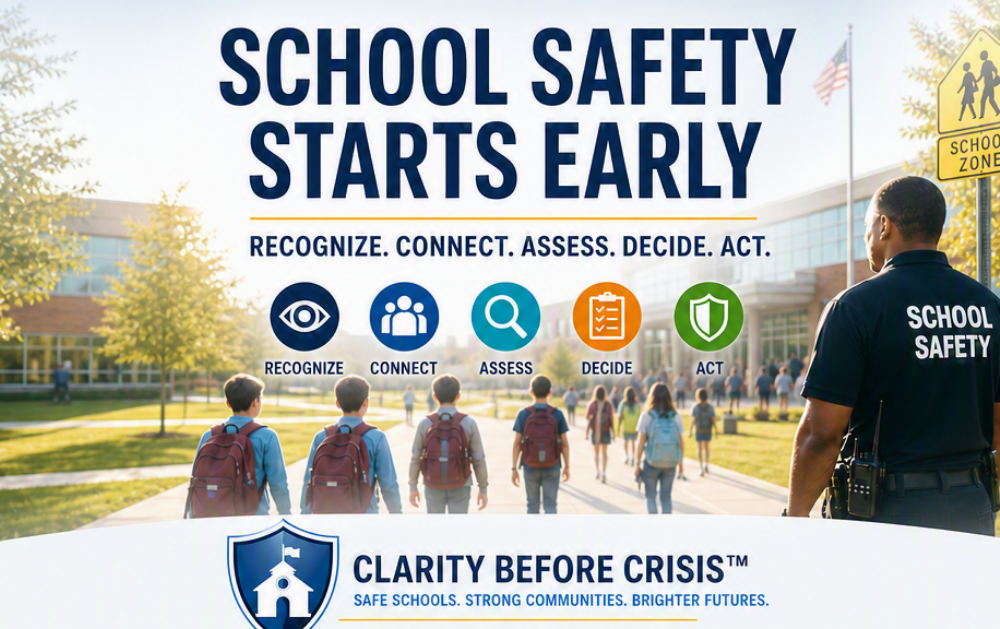
Why Early Recognition Matters More Than Emergency Preparedness
Schedules are finalized. Staff return. Students arrive. Policies are reviewed. Drills are conducted. Security measures are checked. All of that matters.
But the most important question is: what are we doing with what we see before something happens?
Effective school safety is not only about preparing for the worst day. It is about recognizing the behaviors, changes, concerns, and missed connections that often come before it.
The Warning Sign Rarely Looks Like a Warning Sign
Concerning behavior rarely arrives with a label attached. It may look like:
- A significant change in behavior
- A growing grievance
- Fixation on a person, issue, or perceived wrong
- An escalating conflict
- A disturbing comment
- A sudden deterioration in relationships
- A student, employee, or visitor behaving differently
Any one of these may have a reasonable explanation. And that is precisely why behavioral risk assessment is difficult.
Recognition is not prediction. Schools should not assume that concerning behavior means someone will become violent. But uncertainty should not become a reason to ignore what people are seeing.
The goal is not to predict danger. The goal is to recognize behavior early enough to preserve options.
The Problem Is Often Not Information — It Is Connection
Inside a school, information is everywhere:
- A teacher notices a change
- A counselor hears a concerning statement
- An administrator receives a complaint
- A parent raises a concern
- A student reports an interaction
- A school resource officer recalls an earlier incident
Each piece may seem incomplete. Each person may assume someone else has the larger picture. This is where risk develops.
The organization may have the information — but not the connection. The critical question is not "did someone notice?" It is: "did anyone connect what was being noticed?"
Assessment Does Not Mean Accusation
Taking a concern seriously does not mean assuming the worst.
- Assessment does not mean labeling someone dangerous
- Intervention does not automatically mean punishment
- Asking questions does not mean a decision has already been made
A mature school safety culture can say: "Something here deserves a closer look" — without immediately saying, "We know what this means."
That preserves fairness, proportionality, due process — and most importantly, options.
Start With What You Know
When a concern emerges, begin with the facts:
- What was observed?
- What was reported?
- What has changed?
- What has been verified?
- What is documented?
- What information is coming from different sources?
Facts matter. But facts without context can mislead. Which is why the next question matters just as much: what don't we know?
- What information is missing?
- Are there competing explanations?
- Is this isolated or part of a pattern?
- Who else may have relevant information?
- What needs to be verified?
- What would change our assessment?
Uncertainty is unavoidable. But uncertainty should lead to better questions, not paralysis.
What Are We Going to Do About It?
This is where leadership begins. Not every concern requires the same response:
- Some situations require a conversation
- Some require additional information
- Some require intervention
- Some warrant a multidisciplinary behavioral threat assessment
- Some require immediate protective action
The response should be based on circumstances — not fear, assumptions, or hindsight. One principle should remain constant:
Do not wait for certainty when responsible action can begin with clarity. You do not need to know exactly what will happen next to determine what should happen next.
The Danger of Waiting for the Crisis
Once a crisis begins, choices narrow. The organization stops asking "what options do we have?" and starts asking "what do we have to do right now?"
Early recognition creates options. Waiting eliminates them.
School Safety Is a System — Not a Single Function
No single person can carry the responsibility for school safety. Teachers cannot do it alone. Administrators cannot do it alone. Counselors cannot do it alone. School resource officers cannot do it alone. Security cannot do it alone. Parents cannot do it alone.
Effective school safety requires people to:
- Recognize what they are seeing
- Connect relevant information
- Assess circumstances and available facts
- Decide what response is appropriate
- Act before options unnecessarily narrow
This requires more than policy. It requires a culture where people know what to report, feel responsible for speaking up, and understand what happens after a concern is reported.
The Questions Every School Should Be Asking
As the school year begins, ask:
- What are we seeing?
- What are we hearing?
- What has changed?
- Are we connecting information across people and departments?
- Do staff know what to report?
- Do they know what happens after they report it?
- Do leaders know who owns the next decision?
And the most important question: are we waiting for behavior to become unmistakable before deciding it deserves attention? If so, we may already be waiting too long.
Clarity Before Crisis™
The goal of school safety is not to treat every concerning behavior as a threat. That creates fear, overreaction, and mistrust. Nor is the goal to dismiss concerning behavior until it becomes impossible to ignore. That creates missed opportunities.
Recognize. Connect. Assess. Decide. Act.
The earlier a school can do those things responsibly, the more options it has. Because the most important moment in school safety may not be the moment the crisis begins. It may be the moment someone first notices that something has changed.
Key Takeaway
School safety is not simply about preparing to respond to a crisis. It is about recognizing concerning behavior, connecting information, assessing risk, and making responsible decisions early enough to preserve options.
The school year has started. Let's make sure we aren't simply prepared to respond to the next crisis. Let's be prepared to recognize what comes before it.
About the Author
Joseph Paul Manley
Founder of Risk Mitigation Technologies, LLC and creator of the P.R.E.V.A.I.L.™ Leadership System. More than 35 years of practitioner experience in behavioral risk, workplace violence prevention, and crisis leadership.
Next Step
Bring behavioral threat assessment clarity to your organization.
Risk Mitigation Technologies works with leadership teams to build recognition, reporting, and decision pathways that hold up under scrutiny.